
Future You Doesn't Have to Wait
Hubby and I were talking this week about something I told him a while back. I read it somewhere, or maybe I heard it, I honestly can't remember where. The idea is this. We think a lot about firsts. We barely think at all about lasts.
There was a last time somebody carried you up to bed. You have no idea when it was. Same with the last tree you climbed, and the last night you stayed outside playing until the streetlights came on and you went in for dinner like it was any other night. There was a last time you got picked up from school. A last sleepover where you stayed up too late.
Nobody stopped you on the way out the door and said, well, that's the last one.
It isn't always about dying, either. Sometimes something shifts. Your body changes or your circumstances change, and you just never do that thing again. Hubby brought it up this week because of his parents, and the last time you drive a car.
We are getting ready to start living part of our life in San Diego, and it comes with a pile of firsts. There's a house we've never lived in and a whole community where I don't know a soul yet. The grocery store is new too, and I have no idea where they keep the good olive oil. Firsts always get the recognition. They're the ones that end up on Instagram.
But the in-betweens are where the life actually happens. It's the ordinary Tuesday when nothing is going on and you take a walk, or you pick up the phone when your friend calls instead of letting it go to voicemail. Those are the ones that turn into lasts without announcing themselves.
The future you exercise that started this
Some of this comes from my mentor, Kasey Jones, of the Essentialist CEO Collective. When you start with her, she has you do a future you exercise.
I have done versions of this before. Hers was different. It pulled out what I want my life to look like ten years from now in a level of detail I did not expect. Not goals, but the actual texture of the day.
Then she does the part I love. She has you step back and break it down. What does five year you have to do so that ten year you gets there? What does three year you need to have in place? What about one year? And then you can keep going, all the way down to what today needs to look like if that life is going to happen.
So I did it. And somewhere in the middle of doing it I stopped and thought, wait.
Why am I waiting?
Not in a dramatic way. I just looked at the ten year picture and realized a good chunk of it isn't actually ten years away. Some of it I could be doing now, this year, this month, if I were willing to arrange things differently.
That question is a big part of why we bought in San Diego now instead of at retirement. We didn't want to set it up for later. We wanted to be in it.
What I'm actually protecting
This is also why I love being an entrepreneur, and it has very little to do with business.
My why is that when my daughter calls, I answer. I can take the trip with my family instead of hearing about it after. Being available when somebody needs me isn't something I have to schedule around work. And I can build something that leaves my family more than I started with, so Mark and I get to do these things now instead of waiting on a finish line that keeps moving.
Some of it is small stuff. I want to make pottery and walk every day. I want to play mahjong with my friends and read a book that has nothing to do with work. I wrote more about this side of it in What Are You Trying to Be More Present For?.
And it's the work itself, because nothing makes me happier than watching somebody bring their gift into the world and make a living from it, and then turn around and help their own people with it. That never gets old for me.
So when I say I want my time back, I'm not being precious about it. I know exactly what I want it for.
Getting the time back is an operations job first
This is the part people skip, and it's most of my work.
Before I touch any tool, I look at the week. What's actually on the calendar, and where the same question is getting answered for the fifth time. I call it the five day receipt, and I walked through how to run one in How to Get Your Time Back as a Business Owner.
Then I sort what turns up. The work that needs me specifically is always a smaller pile than anybody expects. Most of what's left needs a person who isn't me, or it needs writing down once so it runs the same way every time no matter who's doing it. And a surprising amount can be dropped entirely, and nothing bad happens.
That sorting is the operations work. It's unglamorous and it's where the time actually comes from. If you hand a messy process to AI, all you get is a messy process running faster.
The written down part has a name. A playbook is the written version of a job, the steps and how you decide along the way, and I get into that in the same post. Once the playbook exists, handing the job off is easy, whether it goes to a person or to AI.
The five ways to put AI to work
Here is where most people get stuck, and I say that with love.
Most people are using AI to write an email. That's it. That's the whole use. Writing an email is fine, it just happens to be the smallest thing you could possibly ask. If you're at that stage, start with What Should I Use AI For First in My Business? and come back here.
Rachel Woods taught me the QUEEN method in her AMP training. The QUEEN method (download graphic here) is five ways to put AI to work: Questioning, Uncovering, Emulating, Executing, and Navigating. I didn't create it, but it lives in my head now, because it sorted out something I had been doing messily. Most of us only ever use one of the five.
Q is for Questioning. AI knows the answer, you ask, it explains. "What's the difference between Zapier and Make?"
U is for Uncovering. You know the thing, but it's a jumble in your head. AI asks you questions until it's clear. "Ask me questions until you get what I'm trying to fix."
E is for Emulating. You give AI a role so you can see your own work through somebody else's eyes. "You're my ideal client. What's confusing on my homepage?"
E is for Executing. You give clear steps and get a first draft back. "Turn these notes into a to do list with owners and dates."
N is for Navigating. You think out loud with AI to work through a big decision. "Help me weigh these two offer ideas. What am I missing?"
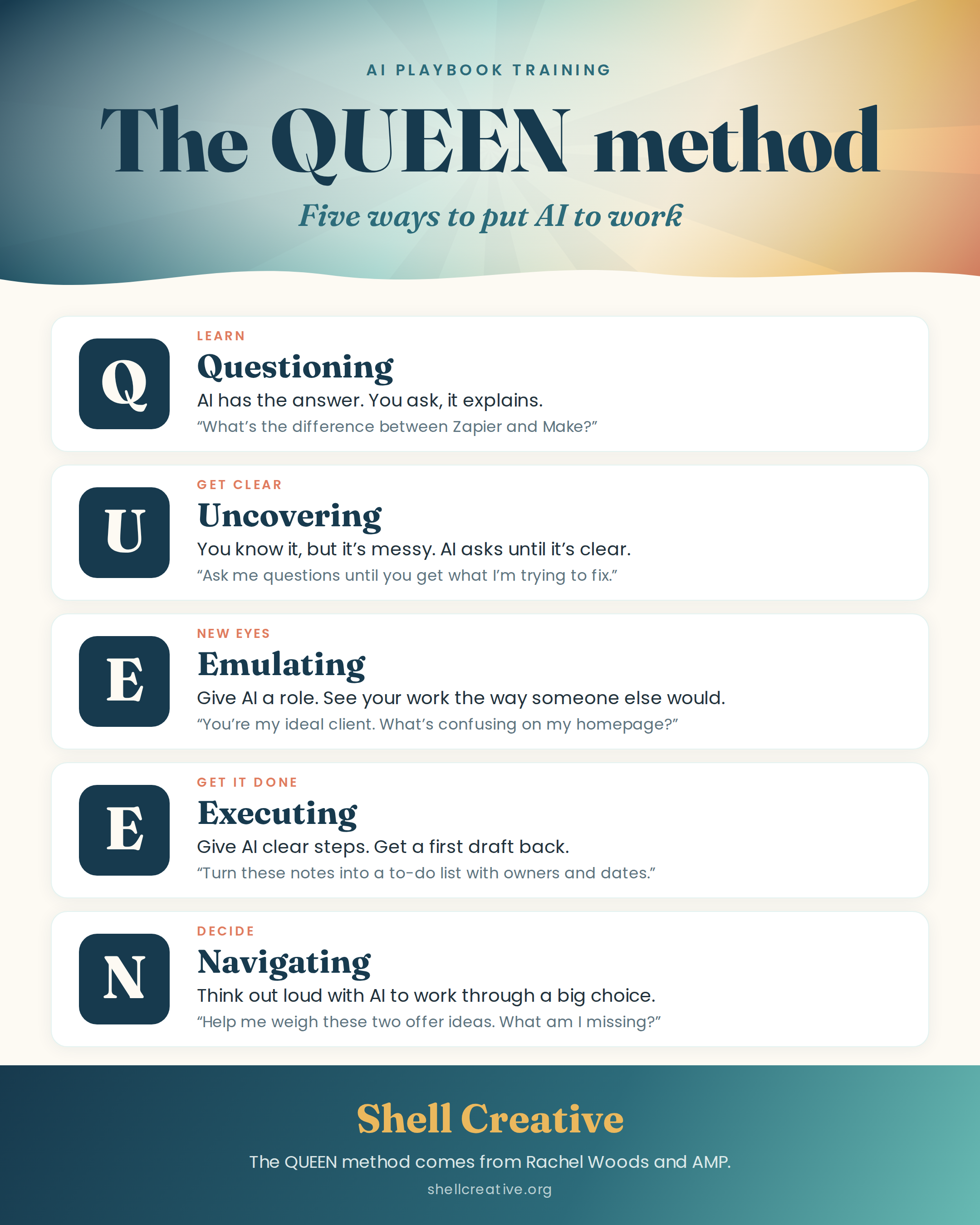
The QUEEN method, five ways to put AI to work: Questioning, Uncovering, Emulating, Executing, Navigating. download graphic
Look at that list and notice how few of them are about writing something for you. Most of them are about getting you unstuck faster, so the thing that used to eat your Tuesday takes twenty minutes.
Time is the reason I do any of this. I don't think of AI as a tool I use. I think about what I can hand off so that I get my week back, and then I go spend that week on the life I described in the future you exercise. The bigger version of that idea is in How to Get Your Business to Run Without You, With AI.
The question I'd ask you
You don't need to buy a condo across the country. That's my version.
But do the small piece of it. Picture the you of ten years from now, in detail. Then work backward and ask what today would need to look like for that person to exist. And then ask what I asked. Why does any of that have to wait?
Usually the honest answer is that your days are full of work that doesn't need you specifically. So start there. Run the five day receipt, sort what comes back, and then pick one of the five QUEEN moves and use it on something that normally eats an afternoon.
Because you're not going to get a heads up on the lasts. What you get is the ordinary days in between, and you get some say in what's in them.
If this resonates, comment below or send me a message. I'd love to know which of the five you're going to try.
Shell, Yes! Here's to your success,
Michelle
FAQ
-
Five ways to put AI to work: Questioning, Uncovering, Emulating, Executing, Navigating. I didn't create it. I learned it from Rachel Woods, founder of AMP, in her AI playbook training. Most people only ever use Executing, which is the "write this for me" one, and miss the other four.
-
No. The first pass is operations. Sort what needs you, what needs a person, what should be written down once, and what can be dropped. AI comes after that. A messy process handed to AI is still a messy process.
-
Start with Uncovering. Pick something in your business that feels messy and tell AI, ask me questions until you understand what I'm trying to fix. It's the fastest way to get something out of your head and into a shape you can work with.